
Mission Statement
Structural inequities in training, hiring, and accessibility have long limited underrepresented artists, including women and gender-expansive musicians, from full participation in the professional life of the theatre. Maestra believes that creative excellence and cultural equity are inseparable and demand sustained intervention. Through Maestra’s Directory, mentorship, and advocacy, as well as through our RISE Directory and network partners, we provide support, visibility, and community for our members and allies as well as year-round programming designed to build lasting models for equity across the theatre industry.
Values Statement
Maestra is a movement.
We are a collective of people endeavoring to champion the diversity of musicians, artists, and craftspeople who work in the musical theatre industry.
We have a bold vision for an industry that is diverse, equitable, inclusive, and accessible across all intersections of gender identity and expression, race, sexual orientation, physical and intellectual ability, age, nationality, and appearance.
We seek to build, apply, and own our collective power.
To these ends:
We value relationships. We practice radical collegiality to champion each other as individual professionals and nurture connectedness among us.
We value transparency. We share our knowledge to help each other thrive.
We value collaboration. We encourage participation from our members and respond to new ideas and initiatives.
We value partnership. We coordinate with other groundbreaking leaders and organizations because this movement is larger than us.
We value solutions. We take practical steps to support individual members while driving toward cultural and systemic changes that benefit our entire global community.
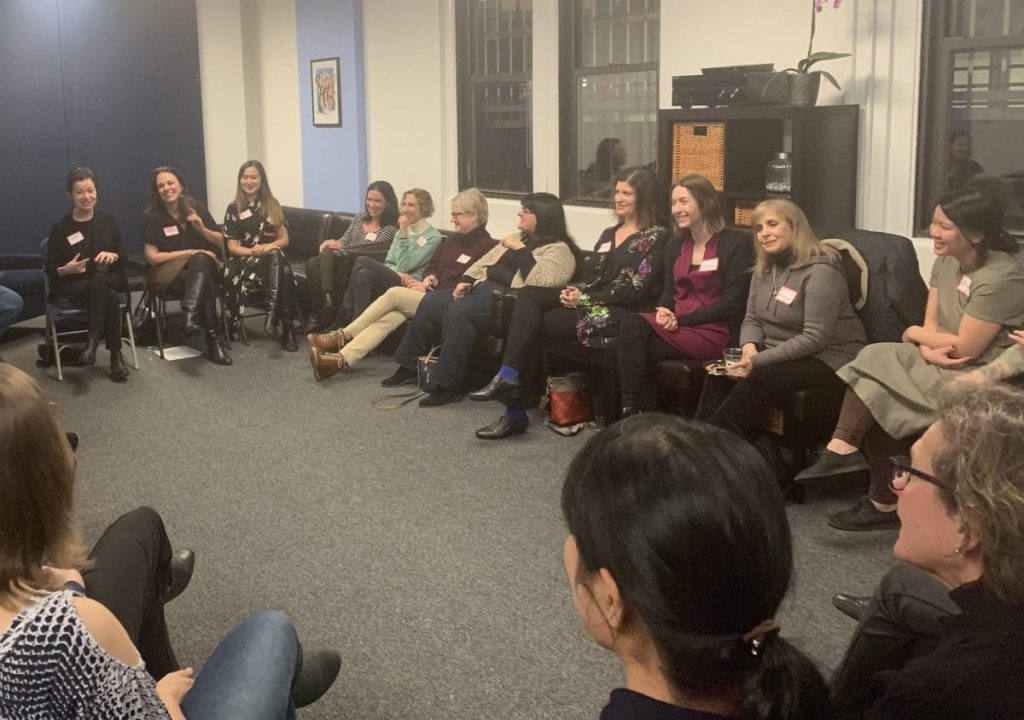
Our Earliest Meetings
Read about how it all began, back in 2017.
History
Maestra began in early 2017 as a series of informal New York City gatherings hosted by Composer/Lyricist and Music Director Georgia Stitt. Georgia worked as the Music Director of the Off-Broadway revival of Sweet Charity, and the difficulty that team had finding and hiring an all-female band illuminated a problem: women musicians seemed to be invisible.
The informal gatherings grew larger each month and turned into organized meetings with invited guest speakers. The group chose the name “Maestra” as the feminine counterpart to the traditional “Maestro,” which refers to an eminent composer, conductor, or teacher of music. Georgia hired a web designer to turn her crowd-sourced spreadsheet of women composers, lyricists, conductors, orchestrators, bookwriters, and pit musicians into an online directory, and musicians began to sign themselves up. Maestra was filling a great need in the theater community, linking women and gender-expansive music-makers and shining a spotlight in their direction to empower them collectively and individually. As of December 2025, the Maestra Directory has over 2900 members located in theatre markets around the globe, including all major US cities, Canada, Mexico, the UK, Australia, Europe, South Korea, and Japan. Maestra was incorporated and received 501(c)3 status in January 2019, naming the mission of providing the members of this directory and its allies with support, visibility, and community.
In March of 2020, when a global pandemic shut down the entire business of producing theater, Maestra pivoted. Not only did the organization survive that very difficult year, but it grew, gathering its members and supporters in online workshops and conversations, building communities and sharing resources. Through the website and social media channels, Maestra created an international network that now has over 20,000 stakeholders including members, subscribers, partners, donors, mentors, and ambassadors. This community’s collective power is changing the theatre industry.
In the summer of 2021, as the theater industry returned from the pandemic, Maestra partnered with two other nonprofit community partners – MUSE and Arts Ignite – to collect data, centralize information, and host industry-wide conversations about equity in the theater. The work caught the attention of Lin-Manuel Miranda, and in 2023, in partnership with the Miranda Family Foundation, Maestra launched RISE Theatre, a program that centralizes toolkits, initiatives, and resources from other organizations fighting to effect change in the American theater. By highlighting these tools, RISE links theatre artists and workers with job opportunities, nonprofit arts service organizations, and industry-wide statistics and resources, ensuring that those with hiring and decision-making power can both find and create equitable environments for marginalized artists and arts workers. Currently building industry coalitions among 45 Network Partners, RISE’s work is centered by the RISE Theatre Directory, which is open to everyone (except actors) who works in the theatre. Modeled after the Maestra Directory, the RISE Theatre Directory serves administrative, backstage, and creative artists in the performing arts so that candidates from marginalized communities (including but not limited to people of color, women, trans, nonbinary, deaf, and disabled theatre professionals) can be seen, considered, and hired. As of December 2025, the RISE Directory has over 3900 members. A video PSA built for the program’s launch appeared at the 2023 Tony Awards and on LinkNYC screens throughout NYC, and RISE was chosen for Variety Magazine’s 2023 “Ten To Watch On Broadway” list. In addition to RISE and both the Maestra and RISE Directories, Maestra’s other key programs include Maestra Mentorship, First Takes, Maestra Care, and several Regional and Affinity Groups. The organization produces Amplify in the spring and the RISE Summit in the fall, as well as supporting many other salons, workshops, and networking events throughout the year.
DATA
In 2021, Maestra collaborated with the NYC chapter of the American Federation of Musicians (Local 802) and surveyed their membership. The publication of the results revealed that only 29% of the chapter’s membership was female and that the number of female-identifying musicians who work specifically on Broadway was 22%. (Only 1% of the membership stated they were genderqueer, genderfluid, or nonbinary.) Between 2010 and 2020, only 8% of new Broadway scores were composed by women, and out of 98 available Broadway drum chairs, 96 were held by men.
Maestra began collecting Broadway musician data from publicly available sources and cross-referencing the findings with personal verifications from shows’ music departments and from the musicians themselves. Based on Maestra’s study of the 2023-2024 Broadway season, female and nonbinary (F&NB) representation averaged 39% in pits and 28% on music teams (including Composers, Lyricists, Music Supervisors and MDs, Conductors, Orchestrators, and Contractors). 14% of that season’s scores were written by women composers (24% lyricists), and 60% of the season’s shows were contracted by women, all of whom are Maestra members. (There were no nonbinary composers or lyricists on Broadway that season.) Three new drum chairs were held by women, and all of the Broadway orchestras had at least one woman or nonbinary player.
What does this mean? Since Maestra was founded, the number of all-male orchestra pits on new Broadway musicals dropped from 25% to 0%. The 2023-2024 season showed a 200% increase in F&NB composer representation over the previous decade.
However, in the 2025-2026 season we are seeing a regression, which has to be considered in light of great political change affecting the climate around both gender equity work and nonprofits in general. In this season, so far, F&NB pit representation is down 28% from last year, music team leadership representation is down 14%, and we’ve seen our first all-male pit orchestra since before Maestra’s founding. There is still almost no representation of F&NB orchestrators at the Broadway level, and we are aware of only one new musical coming in this season that even has a woman composer on the creative team.In a time that sees equity work (and even the language used to describe it) challenged in companies, schools, and courtrooms across America, Maestra insists that you can be pro one group of people without being anti everyone else. We keep bumping into this idea that in order to promote women and gender-expansive people we have to put men out of work. It’s just not true. Some of the organization’s greatest allies are the male composers and music directors who have gone out of their way to hire a Maestra conductor, orchestrator, sound designer, or music contractor, and the male producers who are now using the RISE Directory, to diversify their teams in all hireable areas including directors, designers, front of house staff, marketing and social media teams, ASL interpreters, consultants, and so much more.
In 2023 Maestra won an Obie Award “for building a movement to support and advocate,” and in 2024 Maestra was invited to curate a panel called “How Maestra Music is Changing The Theatre Industry” for New York Music Month hosted by the NYC Mayor’s Office of Media and Entertainment. Maestra’s team refutes the idea that any industry job can only be populated by one kind of person. The world is full of so many diverse stories. Our theatre is richer when its community of artisans and craftspeople is, too.